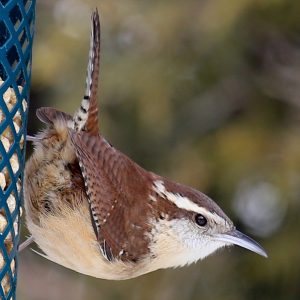
Carolina Wren, by David Small
Our bird feeders have seen an increase in bird activity with all of the recent snow. Often, many birds are stopping in for a meal at the same time. But, that doesn’t mean they all are able to sit at the table, so to speak. With limited space, it’s not surprising that situations arise in which one species displaces another and takes over the feeding opportunity. We’ve often wondered, how often does our overwintering Carolina Wren, a feisty bird, drive off a House Finch? What about a House Sparrow? Do other species sit up and take notice when a Blue Jay shows up? Who more often wins the battle at the suet, a Downy Woodpecker or a Hairy? The Black-capped Chickadee is hardly a shy bird—how do they fair in competitive interactions at the feeders?
It would be impossible for us to answer these questions ourselves. Fortunately, our former colleagues at the Cornell Lab of Ornithology asked participants in Project FeederWatch to record the winners and losers of competitive interactions, when possible. They came up with a unique dataset that allowed them to construct the first-ever dominance hierarchy for 136 species of North American birds that frequent backyard feeders.
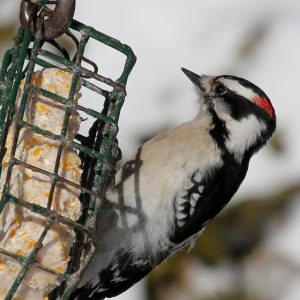
Downy Woodpecker, by David Small
The first of a series of research papers from the dataset was published in 2017 under the wonderfully descriptive title: “Fighting over food unites the birds of North America in a continental dominance hierarchy.”
It comes as no big surprise that the researchers found that the largest birds were at the top of the list of most dominant. Anyone who has Wild Turkeys coming to feed in the backyard knows there aren’t really any other birds that will tangle with something that big! True, they’re not immediately comparable to other “feeder birds,” but Wild Turkey was at the very top of the list.
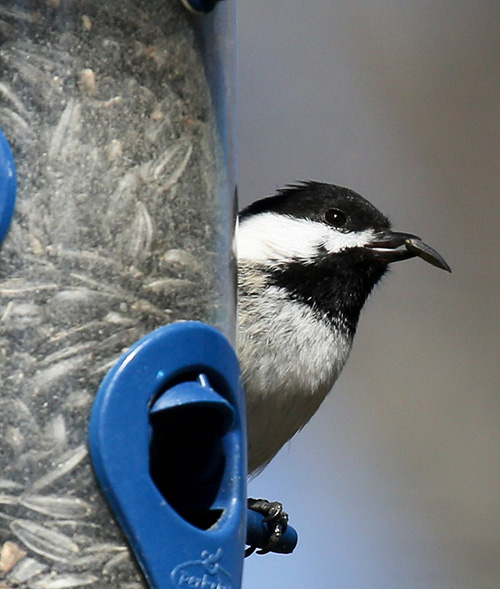
Black-capped Chickadee, by David Small
Other larger birds that were among the most dominant included Common Ravens and American Crows, as well as Canada Goose and Mallard. There were some oddities in there, too—birds that don’t occur as often at backyard feeding stations like Great Blue Heron and Herring Gull.
What we were most interested in were those smaller, more typical feeder birds. Did even these birds occur higher in the dominance ranking than expected based solely on their size? One of the best examples is within the woodpeckers. There are 13 woodpecker species in the top 50. That puts them with Blue Jay and Red-winged Blackbird. There are 12 woodpeckers listed as more dominant than European Starling (though not our familiar Hairy and Downy Woodpeckers). The authors guessed that the proportionately long bills and strong pecking abilities of woodpeckers made them formidable foes in competitive interactions even with larger birds. And by the way, within the woodpeckers, Hairy Woodpeckers do dominate over the smaller Downy Woodpecker.
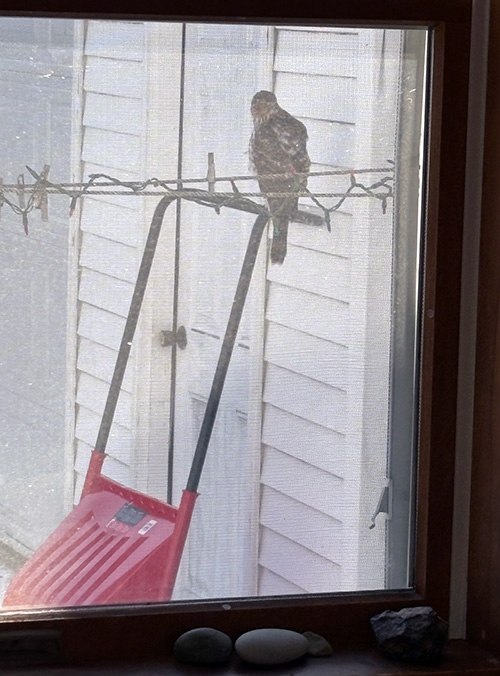
Hierarchy scatters to the wind when the resident Cooper’s Hawk shows up! Here, the bird is cleverly perched on the authors’ snow scoop for easy access to the bird feeders. Photo courtesy of Jeff Wells.
Small birds, even those with spunky reputations like Black-capped Chickadee, dominate the bottom of the list. American Goldfinch, you may or may not be surprised, are at the bottom of the pecking order. Carolina Wren, to our surprise, appears below House Sparrow, Song Sparrow, and White-throated Sparrow! However, they are above Tufted Titmouse and House Finch. We were surprised to see Song Sparrow listed above White-throated Sparrow and House Sparrow, considering it is smaller than the latter two species, but in the days reading the study, we’ve witnessed a Song Sparrow feeding peacefully on the edge of our platform—until a few House Sparrows showed up! The Song Sparrow went after those birds with its feet in the air, talons like tiny daggers, and bill wide and snapping! The House Sparrows did not hurry back. Likewise, our overwintering White-throated Sparrow got a lashing from the Song Sparrow when it merely contemplated coming in for a meal.
The authors note that there are exceptions in individual cases and that there can be geographical variation and likely seasonal differences in how birds interact as well. Still, this first-of-its-kind dataset is very revealing, and scientists are probing it for even more fascinating results.
The question of who was most dominant at the feeders in our yard is often resolved by the arrival of a furry creature who displaces the birds in all directions—gray squirrel! But even the squirrel hightails off when one bird in particular shows up, and that is our resident Cooper’s Hawk!
—Jeff and Allison Wells





Leave a Reply