For more than half a century, the Clean Water Act has helped curb pollution flowing into our rivers, lakes, and streams. And now the safeguards that are embedded in this landmark environmental law are at risk due to changes being proposed by the U.S. Environmental Protection Agency’s (EPA) Administrator Lee Zeldin.
The Clean Water Act has deep ties to Maine. It was a crowning accomplishment for Senator Edmund Muskie, who grew up in Rumford and was prompted into action because he saw that our rivers were being treated as open sewers. His determination to remedy that resulted in one of the nation’s most important environmental laws, and now, our waterways and drinking water are safer and cleaner because of it.
The Natural Resources Council of Maine has always stood with Mainers to protect clean water. We recently submitted comments to the EPA voicing concern and opposition to its proposed “Waters of the United States” rule that redefines which wetlands and waters have Clean Water Act protections. The proposed change would leave up to 97% of non-tidal wetlands in Maine without these federal protections, removing a crucial policy backstop and creating uncertainty for our drinking water, flood protections, and critical habitat.
We’re opposing the weakening of federal clean water protections because polluters should not get special treatment over the health of our people and environment.
Maine is known for clean water. As the most forested state in the country, with a relatively small population concentrated in urban areas along the coast, Mainers today reap the benefits of high water quality in our inland lakes, rivers, streams, and wetlands. The state’s pristine waters are a principal driver of tourism here in Maine, where “Vacationland” is proudly printed on our license plates, and, as an industry, attracted more than 15 million visitors and contributed $9 billion to the economy in 2023. It also directly supports jobs in the fishing, outdoor recreation, and real estate sectors, to name a few. It’s the reason why our state is home to the last stronghold of native brook trout in the eastern U.S.
Around the same time that the Clean Water Act was created, several state laws were also passed here in Maine that protect water resources. These include the Site Location of Development Act, the Mandatory Shoreland Zoning Act, and the Natural Resources Protection Act.
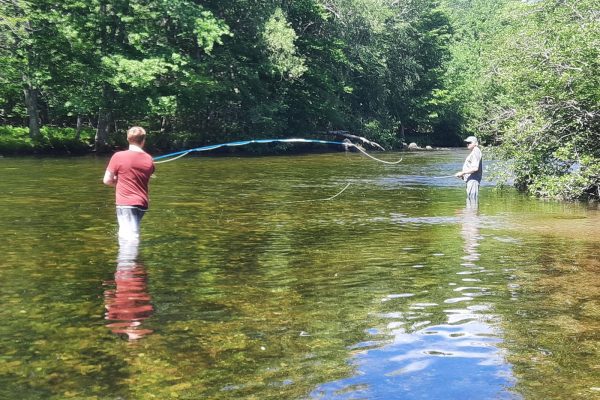
Fishing on Grand Lake Stream, photo courtesy Allison Wells
As a result of the U.S. Supreme Court’s 2023 decision on Sackett v. EPA, many wetlands and small streams around the country that lack a “continuous surface connection” to “traditional interstate navigable waters” were stripped of protections awarded under the Clean Water Act.
Fortunately for us here in Maine, these resources still have substantial protection under the three state laws mentioned previously. However, with the Clean Water Act no longer in play, we are missing an important safeguard that served as a critical second line of defense for decades.
We also know we can’t take our state’s clean water laws for granted. Back in 2011, several pieces of state legislation designed to rollback key environmental protections under these three laws were introduced in Maine as part of an anti-regulatory campaign brought forward by Governor LePage. This included an effort to substantially weaken the Site Location of Development Act (LD 159), five different efforts to weaken the Mandatory Shoreland Zoning Act (LDs 219, 339, 434, 888, and 1108), and three different efforts to weaken the Natural Resources Protection Act (LDs 156, 387, and 872).
These proposed changes were fought by environmental groups across the state, and although they were each threatening in their own ways, organizations like NRCM felt assured at the time that no matter what happened, our waterbodies would still be subject to federal protection under the Clean Water Act. If these changes go into effect, that assurance will be gone for many streams and wetlands here in Maine whose protection now lies solely with state and local governments.
EPA Administrator Zeldin’s proposed rule change favors polluters and fails to listen to the thousands of Mainers who are demanding strong protections for clean water. If finalized, the rule would fail to meet the needs and protections of communities, ecosystems, and waterways in Maine and across the United States.
After recent federal rollbacks, a strong definition of the “Waters of the United States” rule is even more essential for protecting wetlands and waterways. Robust clean water protections are critical to prevent industrial polluters from bending the rules and threatening the health and safety of people and wildlife.
We can’t protect Maine’s future if we don’t protect the health of our environment. Maintaining strong, common-sense environmental laws are needed to protect the outdoor spaces we all love.
Learn more about the proposal to weaken the nation’s Clean Water Act:
—Anya Fetcher, NRCM Federal Policy Advocate




Leave a Reply