Maine’s Tradition of Public Access: A Privilege, Not a Right
September 9, 2026
by Frances Killea, Policy Advocate, Woods, Waters, & Wildlife
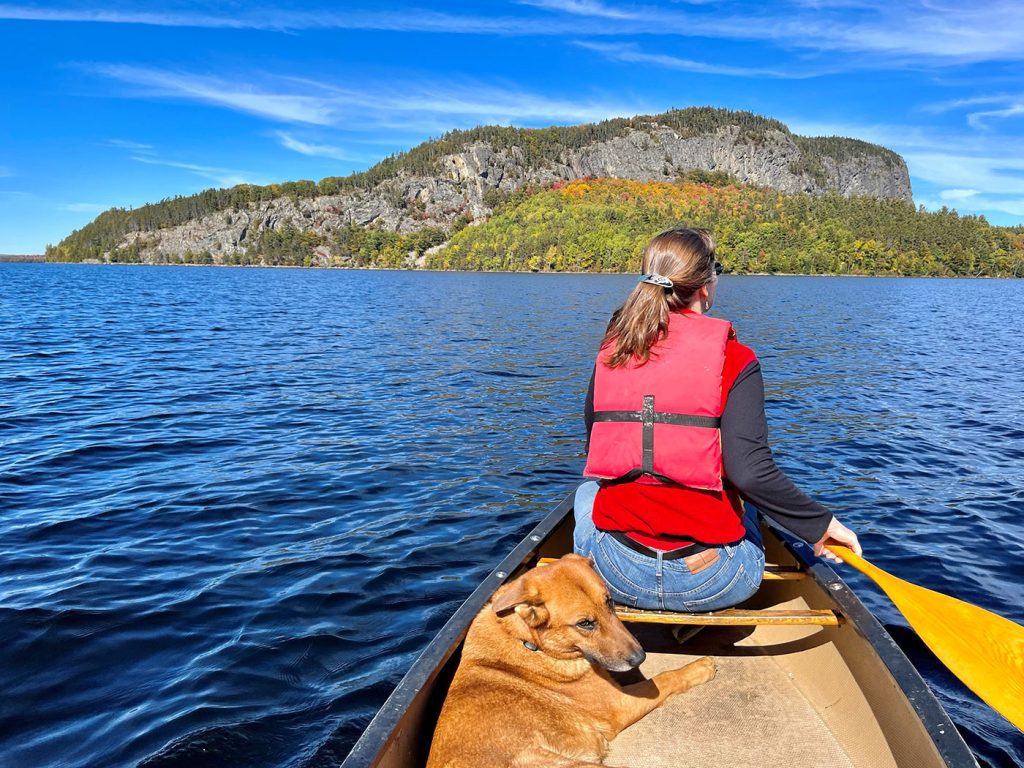
If you’ve driven up the Golden Road on your way to explore the Debsconeag Lakes Wilderness area or paddle the Allagash Wilderness Waterway, crossed through a North Maine Woods gate to explore Gulf Hagas, Debouille Public Reserved Land, or spent a winter weekend racing down remote snowmobile trails, then you’ve enjoyed one of Maine’s unique and defining traditions: public access to private land.
Many across the state have become concerned about reports of trails closing or access to lands that were historically available being blocked. A new report released in 2026 details strategies for how the state can work with landowners and others to protect this rich tradition of public access.

Vast Undeveloped Areas Mostly in Private Hands
Maine has a vast number of undeveloped acres. The nearly 90% forested land cover eclipses other states in the eastern United States, even surpassing our other Northern New England states of Vermont and New Hampshire.
However, Maine has less land in public ownership than our neighbors; 92% of the state is in private hands. But Mainers and visitors have long enjoyed fishing, hunting, and hiking in nearly half of that area—about 10 million acres—anyway.
This enduring tradition of landowners allowing the public to travel and recreate on their private land is reflective of the state’s implied permission laws: if a property isn’t posted, it is implied that the landowner has allowed public access. This access, however, has always been a privilege, not a right.
For generations, most of the private land here in Maine was owned by timber companies: industrial corporations that vertically integrated here to manage forests, feed mills, and create wood products. These companies employed entire communities and opened access to their forestlands to the public for recreation.

Around the turn of the 20th century, industry shifts drove changes in landownership, with massive parcels changing hands in a matter of years. Some of these parcels were acquired by conservation organizations; others are now under large family ownership or REITs and TIMOs (see definitions of each in box below), with industrial ownership accounting for less than 10% of privately owned land. Even with the change in ownership, in many cases, public access to these forests was maintained.
Alongside changes in landownership, Maine’s forests have begun to experience a shift in how they are used, deepening the impacts of recreation on the land and stressing resources, sometimes to a breaking point. This, and other shifts in landowner objectives, have brought about a wave of restricted access, and the public is finding some favorite destinations—many enjoyed for generations—cut off. A recent high-profile example of this is Burnt Jacket Mountain, where a land purchase from an anonymous buyer has resulted in the closure of beloved hiking trails near the town center of Beaver Cove on the shores of Moosehead Lake.

REITs and TIMOs
REIT: A Real Estate Investment Trust is a tax entity (e.g., a corporation) that invests in real estate on behalf of its shareholders; a timber REIT’s real estate investments are primarily in timberlands. A minimum of 90% of the REIT’s income must be distributed amongst shareholders; income distributed from timber sales is exempt from federal income tax and is instead taxed at a lower capital gains rate.
- Weyerhauser
- Rayonier
TIMO: A Timber Investment Management Organization is an entity that manages and purchase timberland for investors (insurance companies, pension funds, endowments). The TIMO is not the landowner, but rather the manager for the landowner (investor).
- Wagner Forest Management
Differences:
REITs are commonly publicly traded entities; TIMOs typically represent private equity interests
TIMO doesn’t own land, REIT does
REIT provides a steep tax incentive (reduction or exemption) for shareholders; TIMO provides relative stability from market fluctuations and inflation
Concerns Around Access Prompt New Report
Landowners have reported a growing chorus of concerns in recent years. In 2024, the Maine Warden Service answered nearly 600 calls for service from landowners. Complaints range from trespassing on posted land to road, trail, and off-road soil degradation, destruction of vulnerable habitat, property damage, littering, wildfire, even squatting.
In 2025, the Legislature responded by passing LD 1308, which mandated the Department of Inland Fisheries and Wildlife (DIFW) to develop a report of strategies to address the conflict between landowners and public access, drawing from a wide range of landowners, recreationists, experts, and the public.
DIFW delivered a Report Back on S.P. 538-LD 1308 in February of 2026. Based on data from North Maine Woods entry fees, hunting and fishing license sales, trail-ready motorized vehicle registrations, and state and federal tourism and economic data, as well as on hundreds of public comments during the drafting process, the report identifies critical areas of tension:
- Changes in landownership
- Unmanaged use of app-driven visitation
- Increased use and degradation of trails and other infrastructure
- Increased costs of and reductions in road maintenance
- Advent/increase of recreation devices (e-bikes, built-out camping vehicles)
- Increase in weight and size of ATVs
As well as some key policy and education gaps:
- Policy/regulatory inconsistency across landowners
- Lack of meaningful enforcement
- Insufficient user education
- Increased environmental liability (for landowners)
- Lack of public resources to support infrastructure
Maine has a legacy of outdoor adventure and recreation, but in the short window of 15 years, the outdoor recreation economy here has doubled, to the tune of nearly $4 billion in 2024. It’s a great boon to a state with major challenges facing other heritage industries, but the growth—without the physical or educational and enforcement infrastructure to support it—has come at a cost.
As landowners hit their breaking points with visitor misuse, the public stands to lose connected snowmobile and ATV corridors, favorite hiking trails, beloved swimming holes, cherished hunting and fishing spots, and more.
The Future of the Handshake Agreement
Amidst such dynamically shifting variables, the balance between landowner protections and Maine’s beautiful tradition of public access may be challenging to maintain, but it is possible, and the Report includes a series of suggested interventions to that effect. Under the umbrellas of three broad approaches, DIFW found several strategies that could help sustain a healthy relationship between the public and private landowners.
- Expand Education About Public Access:
While some organizations offer public access guides (High Peaks Alliance, Maine Forest Products Council) and DIFW maintains the Outdoor Partners Program, offering both user and landowner guidance, information about proper use of private land isn’t reaching everyone. As visitation grows, it’s important to expand education about public access best practices to all users and landowners.
- Increase communication of Maine’s history of public access, emphasizing how important this tradition is and re-establishing that access is a privilege and not a right.
- Strengthen communication with landowners for clarity regarding their property rights and liability laws.
- Work both broadly and locally with interest groups to provide tailored information and training on specific recreational activities.
2. Develop Financial Pathways for Investing in Maintenance:
Increased usage of roads, campgrounds, and hiking trails inevitably causes wear-and-tear on the infrastructure, and the maintenance cost falls upon the private landowner. While some landowners may be able to upkeep areas of heavy public usage, others cannot, and it’s clear that establishing robust and reliable funding sources is a key part of securing the future of public access in Maine.
- Create a dedicated funding stream for private road and infrastructure repair, particularly for very high-use areas or corridors connecting important recreational destinations.
- Create a cost-sharing program to work with landowners on covering costs of maintenance and repair expenses.
3. Ensure State Has Resources for Effective Enforcement:
Staffing gaps in certain agencies hinder meaningful enforcement of rules, and violations go unaddressed with landowners left to bear responsibility for damages. General lack of capacity keeps agencies from developing more effective patrol or enforcement plans.
- Allocating funds to fill vacancies with the Maine Warden Service, Maine Forest Service Rangers, and Marine Service will create more capacity for timely on-the-ground control of misuse of private lands.
- Engage local organizations to help identify high-use or vulnerable areas to target patrol.
- Collaborate with courts and towns to create a more effective and equitable enforcement system. The Report suggests modeling this after traffic court systems.
These strategies, paired with other legislative options and possible incentive programs, could all help shape the future of public access into a system that benefits both landowners and adventurers, and maintains Maine’s long legacy of implied permission.
New CLUP: An Opportunity to Recommit Ourselves to Public Access
Much of the private land Mainers and visitors love to explore is within the Unorganized Territories (UT), or townships that have no local government, under the jurisdiction of the Land Use Planning Commission (LUPC).
The UT is a region unique in the country and sustains globally significant swaths of relatively unfragmented temperate forest, timber and agricultural industries, critical fish and wildlife habitat, and exemplary recreational access.
Within this region—a little over half of the state—the LUPC is responsible for regulating zoning and development and issuing permits for new structures, both residential and commercial. Periodically, the LUPC updates its primary planning document, the Comprehensive Land Use Plan (CLUP), to reaffirm its guiding principles and reevaluate the needs of the UT.
The LUPC has begun to draft some of the forthcoming CLUP’s guiding principles to reflect these characteristics; among others, one such draft principle is as follows:
In 2025, the LUPC began its pre-process in updating the last CLUP (published in 2010). The pre-process includes several public informational sessions focusing on a topic of importance: housing and development, land and wildlife conservation, recreation, forest resources, and others. As the revision process begins, an upcoming public survey will solicit feedback from UT residents and other people who have an interest in the future of the UT regarding their association with the region, primary concerns about development and other issues facing the region, and other feedback relevant to refining the CLUP for the next decade.

This process is designed to field voices from within the UT about what challenges they experience and values they hold.
The LUPC has begun to draft some of the forthcoming CLUP’s guiding principles to reflect these characteristics; among others, one such draft principle is as follows:
“To honor the rights and participation of residents and property owners in the unorganized and deorganized areas while recognizing the unique values of these lands and waters to the State…”
With this—and other pillars that prioritize conservation of the region’s ecological and natural values—in mind, the next CLUP is an opportunity, like the strategies in IFW’s Report Back on LD 1308, to sustain a legacy of mutual respect between private landowners and the public and build a healthy future for public access to Maine’s great lands.


